What this is
UTIAS AER1410H Topology Optimization is the spring-term graduate course on density-based and level-set topology optimization. The coursework chains a problem-set track on the Sigmund 99-line MATLAB family with two larger projects — Project 1 a 2-D cantilever baseline, Project 2 an applied SIMP run on a real aerospace bracket from a Zenith 701 wing rib.
The page is structured to mirror that chain: method first, application after. The textbook truss output sets the visual frame — black material on white, the line every reader recognizes as ‘topology optimization’ — and the bracket figures show the same idea applied where the physics has consequences.
Method internals — Sigmund-MATLAB-style outputs
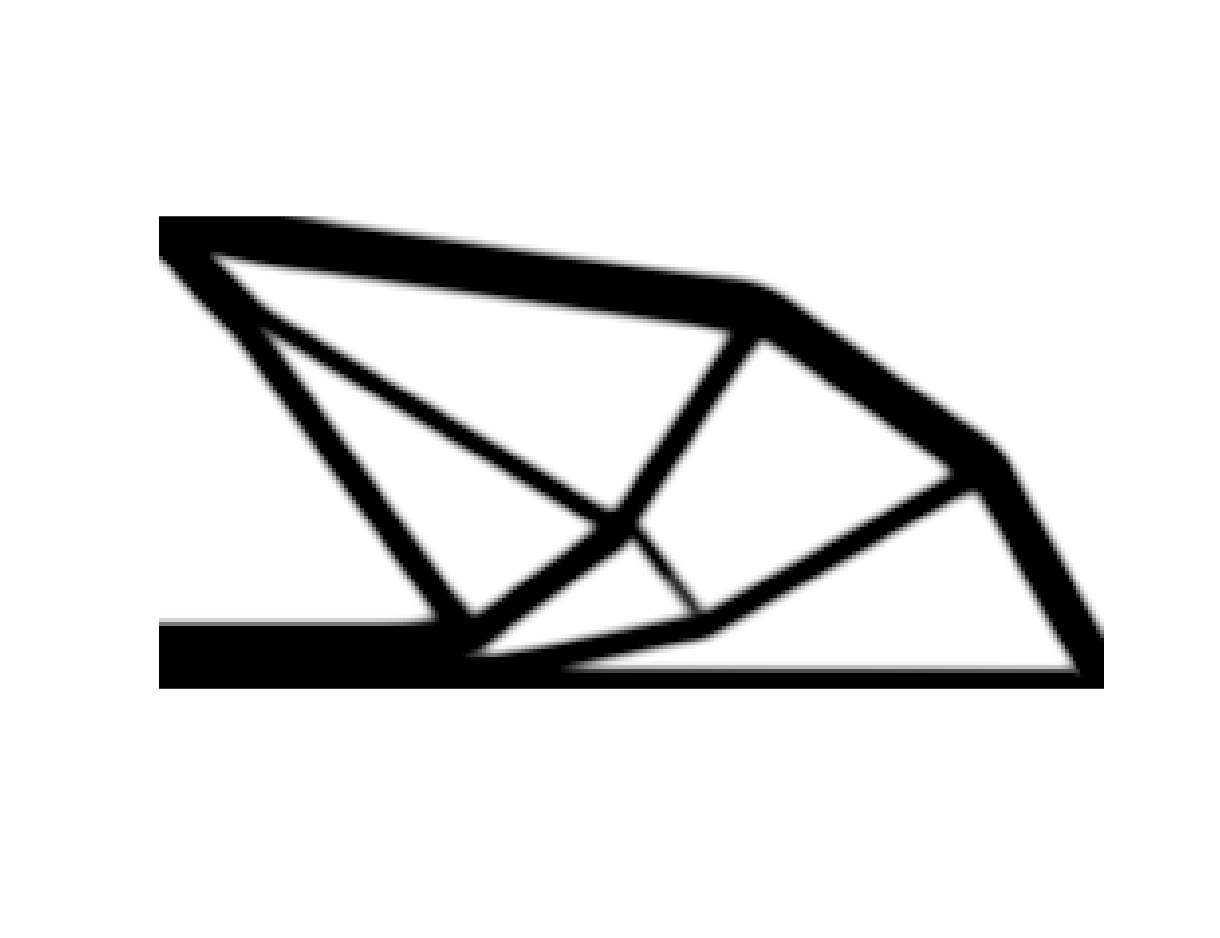
The hero is the doubled-mesh-density bending beam from Problem Set 4. SIMP density distribution under corner-support cantilever loads, run at a finer-than-default discretization to let the truss-like internal structure resolve. Black is material; white is void; the structure between is the optimizer’s answer.
The companion is the density-field contour plot from Problem Set 6 — the same machinery one layer down. SIMP density on a 50×50 grid, the iso-contours showing where the soft penalization pushed the field toward 0 or 1. It is the figure the binary truss is the limiting case of: same field, before the threshold collapses it to black-and-white.
Applied — bracket on the Zenith 701 wing rib
Project 2 takes the SIMP machinery off the cantilever and onto a real bracket. The design domain is the wing rib of a Zenith 701, with the fastener pattern, the load paths, and the manufacturing constraints all coming in from the aerospace context rather than from a textbook. The figures show the bracket at two stages: first the raw SIMP output under the design load case — recognizable as topology-opt by the same visual logic as the textbook truss, but on a 3-D component with the load arrows and supports visible — and then the polyNURBS-fit manufacturable form derived from the same optimization.
The pair is the point. Raw SIMP gives the structurally honest answer; polyNURBS gives the version that survives manufacturing. Showing both is what makes the lane an engineering exercise rather than a method demo.
What it earns
Topology optimization done as a course is the same problem twice — once on the textbook problem where the answer’s visual signature is famous, once on a real component where the same machinery has to absorb load paths, geometry constraints, and a manufacturable downstream form. The page reads in that order on purpose. The textbook truss tells the reader what the method’s outputs look like; the bracket pair shows the method earning a result on a problem that has consequences.